From the therapy room— July 1, 2026— 47 min read
Returning to First-Order Creation
A Biblical Framework for Women, Men, Marriage, and Ministry
“What is actually true, and what does it produce in the lives of real people?”
Purpose and posture
This paper is offered as a companion to the chapter “No More Scripts: Reclaiming Submission” as it appears in The Ahava Way. The chapter is pastoral and formational. It addresses the lived consequences of distorted submission, restores permission for women to discern and speak, and names the conditions under which saying no may be an act of faithfulness to Christ. This paper carries a different burden. It sets out the wider biblical and theological framework from which that chapter emerges.
I am not asking readers to choose between the familiar labels complementarian and egalitarian before opening the text. Nor am I treating disagreement as evidence of bad faith. Many Christians who hold a complementarian position are sincerely seeking to honor Scripture, protect marriage, and order the church faithfully. My focus is narrower, and more foundational: Whether conclusions attached to those labels have sometimes been allowed to govern the text rather than remain accountable to it.
The invitation to examine begins where Jesus began when questioned about marriage. It returns to creation, then follows the biblical story through the Fall, Israel, Jesus, Pentecost, the early church, and the disputed New Testament passages. The goal is not sameness between women and men. The goal is to recover differentiation without domination, union without erasure, service without subordination as identity, and authority reshaped by the crucified Christ.
The Framework of This Paper
This paper is not an argument for choosing the egalitarian side of the complementarian-egalitarian debate. Both frameworks raise necessary questions, and both can become too small when they are made to carry the whole biblical account of women and men.
Complementarianism rightly insists that embodied difference is meaningful and that Scripture must not be reshaped merely to reflect contemporary culture. Yet it can make hierarchy the organizing meaning of difference, extending disputed conclusions about particular church offices into a broader theology of male authority in marriage, ministry, and spiritual life.
Egalitarianism rightly insists upon the equal dignity, agency, gifting, and direct spiritual responsibility of women and men. Yet where equality is framed primarily as identical access to roles, or where sexual difference becomes functionally incidental, it may fail to give sufficient theological weight to the goodness and meaning of male and female embodiment.
The framework proposed here begins elsewhere. It begins with first-order creation: women and men created in the image of God, jointly entrusted with the human vocation, differentiated without domination and standing in corresponding relationship before God. It then traces what the Fall distorted, what Christ restored, how the Spirit equips women and men, and how the apostles ordered vulnerable first-century churches within their historical world.
Its claim is not that women and men are interchangeable, nor that one sex is appointed to rule the other. Equality does not require sameness, and difference does not require rank. The goal is not the reversal of hierarchy or the erasure of distinction, but the restoration of human relationship toward the pattern revealed in creation and embodied in Christ.
A note on method
I do not approach this subject as a seminary-trained theologian or as a representative of either side of the complementarian-egalitarian debate. I approach it as a disciple, clinician, and careful reader of Scripture who has spent years witnessing how theology is carried into marriages, bodies, churches, and lives. This framework emerged through sustained reading, prayer, attention to the language and historical setting of the text, engagement with scholarship across the spectrum, and repeated testing against the whole witness of Scripture. I offer it not as a claim to private revelation, but as an argument to be examined, corrected where necessary, and discerned within the body of Christ.
A note about scope
This paper does not depend on settling whether every church office, including elder or pastor, must be open to women. That question deserves careful, separate treatment. The more basic claim is that a restriction concerning one defined office, even if a church retains it, cannot be expanded into a universal theology of male authority over women, unilateral husband rule, or female spiritual dependence. The office question affects who holds a particular role. The broader subordination question shapes every marriage, every girl’s discipleship, every woman’s use of her gifts, and every church response to coercion or harm.
Women, like men, are fully capable of selfishness, manipulation, coercion, dishonesty, and the misuse of power. Nothing in this paper suggests otherwise. Scripture holds every person accountable for how they use their voice, influence, sexuality, authority, and freedom.
The narrower purpose of this paper is to examine teachings about male authority, female submission, and women’s roles because those teachings have often been reinforced through formal theology, church structures, and appeals to biblical obedience. Naming that particular pattern is not a denial of women’s capacity to cause harm. It is an effort to examine the theological framework that has historically granted one sex greater authority while placing a disproportionate burden of yielding, forgiveness, and relational repair upon the other.
Executive summary
The thesis of this paper is as follows:
The biblical story begins with women and men as equally responsible image-bearers who receive a shared commission from God. Domination enters the story after sin as relational rupture, not as the creation ideal. Throughout Scripture, God repeatedly entrusts women with discernment, leadership, prophecy, theological speech, public witness, and gospel labor. Jesus restores direct discipleship and moral agency to women, and the Spirit is explicitly poured out on sons and daughters so that both prophesy. The household codes address real first-century structures but redirect power toward Christlike self-giving; they do not command husbands to rule or grant them a divine tie-breaking vote. The difficult Pauline passages must be interpreted within this wider canonical witness. Therefore, Scripture does not support a generalized doctrine that women are subordinate to men or that wives exist under unilateral male authority. Christian marriage is best understood as a covenantal union of two responsible image-bearers who belong first to Christ and practice shared discernment, truthful speech, mutual yielding, and self-giving love.
The paper develops eight central claims:
- Personhood and image-bearing precede every social or marital role.
- Genesis presents the human vocation as shared; difference is not introduced as rank.
- The rule of man over woman belongs to the disorder described after the Fall, not to the world God called very good.
- The Bible repeatedly records women speaking and acting with God-given authority, including at decisive moments in redemptive history.
- Jesus and the apostles do not teach female silence as a general spiritual condition.
- The New Testament household texts must be read in their literary, social, and Christological contexts.
- No New Testament text gives husbands a standing right to overrule their wives or commands men generally to exercise authority over women generally.
- A church may discuss the elder or pastor office separately without building a comprehensive theology of female subordination around that one question.
What this paper affirms, and what it does not
This paper affirms the full authority of Scripture. It affirms that women and men are embodied, sexed persons and that difference is meaningful. It affirms marriage as a covenant between a woman and a man, the value of family life, the call to service, the need for ordered and accountable church leadership, and the goodness of sacrificial love.
It does not argue that harm alone determines interpretation, that women are morally superior to men, that every distinction is oppressive, or that freedom means autonomous self-rule. It does not assume that modern Western individualism is the biblical ideal. It does argue that harmful fruit should send us back to examine interpretation and application, especially when a doctrine repeatedly requires the same group of people to become less visible, less heard, less informed, or less able to resist sin committed against them.
- The interpretive method: creation, rupture, accommodation, restoration
A faithful reading of Scripture must distinguish among at least four kinds of biblical reality: creation as God declares it good, rupture as sin distorts it, accommodation as God addresses people within fallen social worlds, and restoration as the kingdom of Christ begins to reorder human life. Confusing these categories produces serious errors. Description can be mistaken for command. A concession can be treated as an ideal. A protective instruction for a vulnerable person can be transformed into a permanent privilege for the powerful.
Jesus models this distinction in Matthew 19. When asked to enter an established argument about divorce, He does not begin with the permissible certificate in Deuteronomy. He returns to Genesis: “from the beginning it was not so” (Matt. 19:8). Moses’ concession addressed hardness of heart. Creation disclosed the deeper purpose. Jesus does not dismiss Moses; He locates the law within the story of sin and points beyond concession toward God’s first intention.
This paper uses the phrase first-order creation to name the relational and vocational reality God calls good before sin introduces shame, blame, domination, rivalry, and alienation. First-order creation is not a simplistic command to reproduce every feature of Eden. It is a hermeneutical horizon. It asks what humanity was made for, what sin damaged, and what Christ restores.
Two additional teachings of Jesus reinforce this method. When Sabbath practice becomes oppressive, Jesus says the Sabbath was made for humanity, not humanity for the Sabbath (Mark 2:27). When His disciples import Gentile models of power, He rejects “lording it over” and defines greatness through service (Mark 10:42-45). In both cases, Jesus moves beneath inherited practice to divine purpose and then reshapes power around human flourishing and His own self-giving life.
The question is not merely, “Can this arrangement be found in the ancient world?”
The question is, “Does this arrangement belong to creation, to rupture, to accommodation, or to restoration in Christ?”
- Genesis 1: shared image, shared blessing, shared vocation
Genesis first identifies woman and man together as the image of God. “God created humanity in his own image ... male and female he created them” (Gen. 1:27). The commission that follows is addressed to both: be fruitful, fill the earth, subdue it, and rule over the other creatures (Gen. 1:28). The grammar is plural. The blessing is shared. The vocation is shared. Nothing in the passage assigns the man a mediating role through which the woman receives God’s word or carries out God’s work.
The image of God is not presented as a private spiritual quality. It is a royal and vocational identity. Humanity represents God’s wise rule within creation. Woman does not receive a smaller image, a derivative commission, or a supporting part in a mission given first to man. Both are addressed by God, both are accountable to God, and both are commissioned to cultivate the world. Carmen Joy Imes has emphasized this image-bearing vocation as the common human identity from which gender relations and work must be understood.1
This does not make women and men interchangeable. Genesis names embodied difference and calls the union of male and female good. But the text does not convert difference into hierarchy. A distinction is not yet a chain of command. A theology that wishes to establish rank must demonstrate it from the text rather than assume that difference requires it.
Creation order is sometimes invoked as proof of authority: the man was formed first, therefore he leads. Sequence, however, does not consistently establish rank in Genesis. Later-created creatures are not thereby rulers of earlier ones, and the woman can as readily be read as the culminating answer to the human’s aloneness. Paul does appeal to creation sequence in specific arguments, particularly 1 Timothy 2 and 1 Corinthians 11, but those uses must be interpreted in their own contexts. Genesis 1 itself gives no gendered hierarchy within the human commission.
- Genesis 2: the corresponding strength who answers aloneness
Genesis 2 slows the creation story and focuses on human relationship. Before the differentiation of woman and man, the central figure is ha-adam, the human formed from adamah, the ground. The first declaration that something is “not good” concerns aloneness: “It is not good for the human to be alone” (Gen. 2:18). The problem is not that the man has too many chores. The problem is that no other creature corresponds to him in shared humanity.
God promises an ezer kenegdo. The noun ezer describes help that is needed and effective. It is frequently used of God’s help to Israel. That fact does not make the woman superior to the man, but it does rule out the claim that the word itself means junior assistant. The question of rank cannot be smuggled into ezer. The phrase kenegdo adds the sense of correspondence, one who is in front of, opposite, or matching the human. She is the human counterpart, neither duplicate nor subordinate species.2
The human’s response is recognition: “This one, at last, is bone of my bones and flesh of my flesh” (Gen. 2:23). The language identifies kinship and shared nature. It is not a job description. The traditional reading that the man “names” the woman in an act equivalent to naming the animals is not required by the wording. He uses a wordplay, ishah from ish, to recognize correspondence. The personal name Eve appears only after the Fall (Gen. 3:20).
The narrative then says that a man leaves his father and mother, clings to his wife, and the two become one flesh (Gen. 2:24). The man’s primary kinship loyalty is reordered around the new union. One flesh includes sexual union, but it is not reducible to intercourse. It names a new kinship reality, a shared embodied, relational, economic, and social life. Paul’s use of the text in Ephesians 5 confirms this bodily logic: to love one’s spouse is to care for one’s own flesh.
This is why woman’s purpose cannot be defined as helping a husband fulfill his calling. What of the unmarried woman, the widow, or the wife whose husband is absent, disabled, unfaithful, or spiritually immature? Scripture never treats her as a person without a mission. Genesis reveals the strength and relational capacity woman brings into human community. Marriage is one setting in which that capacity may be expressed. It is not the source or boundary of her calling.
A careful claim about ezer kenegdo:
The phrase does not prove that women must hold every role, nor does it erase bodily difference. It does establish that the woman is introduced as the man’s necessary human counterpart, sharing his nature and answering his aloneness. Any later theology of role must remain consistent with that foundational dignity and reciprocity.
- Genesis 3: rule as rupture, not mandate
After the humans grasp autonomy from God, the relational world fractures. They hide, blame, protect themselves, and turn gift into threat. In the judgment spoken to the woman, God says, “Your desire will be for your husband, yet he will rule over you” (Gen. 3:16). The man is not commanded to rule. The woman is not commanded to accept rule as holy. The sentence describes what the damaged relationship will become.
The pairing of “desire” and “rule” appears again in Genesis 4:7, where sin desires Cain and Cain is told to rule over it. The exact nuance of “desire” in Genesis 3:16 is debated, but the rule language is not. It belongs to a passage of pain, toil, alienation, and death. Treating male rule as the design to be protected turns a consequence of sin into a moral vocation.
This distinction does not mean every social form that emerged after Eden is wholly evil or that Scripture gives no ordered responsibilities. It means domination cannot be baptized merely because it is ancient. Patriarchal households, polygamy, primogeniture, slavery, monarchy, and other social realities appear within the biblical story. Some are regulated, some are limited, some are used providentially, and many display painful fruit. Their presence in the narrative does not by itself establish them as creation ordinances.
We do not treat thorns as the agricultural ideal or pain as the goal of childbirth. We should not promote “he will rule over you” from diagnosis to design.
- Women in Israel’s story: God-given agency within a patriarchal world
The Old Testament unfolds within patriarchal cultures, but its women are not merely passive beneficiaries of male faithfulness. Again and again, women see, speak, act, judge, preserve covenant life, correct men, and carry the word of the Lord. These narratives do not erase the social constraints of their world. They do prevent those constraints from becoming a theology of female incapacity.
Women whose discernment changes the course of events
The daughters of Zelophehad stand before Moses, the priest, the leaders, and the whole assembly to challenge an inheritance gap. Moses brings their case before the Lord, and God answers, “The daughters of Zelophehad are right” (Num. 27:7). Their speech does not represent rebellion against authority. Their truthful appeal becomes the occasion for Israel’s law to be clarified.
Abigail acts without waiting for her foolish husband’s permission, intercepts David, interprets the moral danger correctly, and prevents bloodshed. David blesses both God and her discernment (1 Sam. 25:32-33). Her faithfulness is not passive agreement with her husband. It requires opposing the consequences of his decision.
Sarah’s judgment concerning Isaac and Ishmael is difficult and morally complex, yet the decisive divine instruction to Abraham is striking: “Whatever Sarah says to you, listen to her” (Gen. 21:12). The patriarch is told to heed the woman’s voice.
Women who lead and speak for God
Miriam is named a prophet and leads Israel’s worship after the exodus (Exod. 15:20-21). Deborah is both prophet and judge; Israelites come to her for judgment, and she gives Barak the word of the Lord (Judg. 4:4-9). Huldah receives the royal delegation after the book of the law is found and authoritatively declares God’s judgment and mercy (2 Kings 22:14-20). The presence of male priests, scribes, and prophets does not prevent the king’s representatives from seeking and receiving the word of God through a woman.
Hannah’s prayer is not private sentiment. It is theological proclamation that anticipates major themes of the kingdom and shapes Mary’s later song (1 Sam. 2:1-10; Luke 1:46-55). Lady Wisdom cries out in public places, stands at the city gates, teaches rulers, and calls the simple to life (Prov. 1; 8; 9). Proverbs 31 portrays a woman exercising economic judgment, purchasing land, producing goods, teaching wisdom, and strengthening her household. Scripture’s own symbolic world does not associate godly womanhood with intellectual or vocational disappearance.
These examples should not be flattened into a modern office chart. Their force is more basic: God does not regard women as inherently unfit to discern, lead, teach, judge, or speak His word. Any interpretation of later restrictions must account for that fact.
- Jesus and women: direct discipleship, direct accountability, direct witness
Jesus does more than behave politely toward women. He treats women as responsible disciples, theological interlocutors, moral agents, patrons, witnesses, and bearers of the kingdom’s message. He does not route their access to God through a father, husband, or male teacher.
Mary of Bethany sits at Jesus’ feet, the posture of a disciple, and Jesus defends her choice to learn (Luke 10:38-42). The Samaritan woman receives one of the Gospel of John’s longest theological conversations and then bears witness to her town (John 4:7-42). Women travel with Jesus and materially support the ministry (Luke 8:1-3). A woman publicly anoints Him and is defended against those who demean her action (Mark 14:3-9). Women remain present at the cross and burial when many male disciples have fled.
Anna and Mary: from the temple to the empty tomb
Luke’s opening chapters place redemptive interpretation repeatedly in women’s mouths. Elizabeth, filled with the Holy Spirit, blesses Mary and recognizes the mother of her Lord (Luke 1:41-45). Mary sings a densely theological song about God overturning pride, power, and deprivation (Luke 1:46-55). At Jesus’ presentation in the temple, Anna is explicitly named a prophet. She gives thanks to God and speaks about the child “to all who were looking forward to the redemption of Jerusalem” (Luke 2:36-38). She is not merely present. She recognizes, interprets, and announces.
At the other end of the Gospel story, women arrive at the tomb, receive the angelic word, and report the resurrection to the apostles (Luke 24:1-10). John gives the commissioning particular clarity: the risen Jesus tells Mary Magdalene, “Go to my brothers and tell them” (John 20:17). She announces, “I have seen the Lord” (John 20:18). Anna speaks about the arriving Messiah at the temple; Mary Magdalene announces the risen Lord at the empty tomb. Richard Bauckham’s work on the named women in the Gospels draws attention to the historical and literary significance of Anna and the resurrection witnesses.3
Anna announces the Messiah at the threshold of His earthly arrival, and Mary Magdalene announces Him at the threshold of resurrection life. Women stand at two great thresholds of the gospel, not merely as recipients but as interpreters and heralds of God’s decisive acts.
This does not by itself settle the later question of elder office. It does settle something prior: a theology of categorical female silence cannot account for the way the Gospels tell the story of Jesus.
- Pentecost: daughters speak because the Spirit is given
At Pentecost, Peter explains the outpouring of the Spirit through Joel’s promise: “Your sons and your daughters will prophesy ... I will even pour out my Spirit on my servants in those days, both men and women, and they will prophesy” (Acts 2:17-18). This is not a marginal detail. It is the inaugural interpretation of the church’s Spirit-filled life.
Prophecy is not identical to pastoral office or to every form of teaching. It is, however, Spirit-enabled speech for the people of God. The explicit inclusion of daughters and female servants means that public, spiritually consequential speech cannot be restricted to men as a class. Acts later notes the four prophesying daughters of Philip (Acts 21:9). Paul assumes that women pray and prophesy in the gathered church and regulates how they do so (1 Cor. 11:5).
The Spirit’s distribution of gifts is not described as an extension of household rank. “One and the same Spirit is active in all these, distributing to each person as he wills” (1 Cor. 12:11). Gifts are given for the common good. Churches rightly test, order, and steward gifts, but they should be careful not to assume in advance that sex determines spiritual capacity when Scripture repeatedly shows the Spirit speaking through women.
- Women in Paul’s mission: co-workers, teachers, patrons, and emissaries
Paul’s letters should not be interpreted only through the few passages that sound restrictive. His actual ministry partnerships provide essential canonical context. Romans 16 names a striking number of women and uses substantial ministry language for them. Nijay Gupta, Cynthia Long Westfall, Craig Keener, and others have demonstrated how easily English readers can understate the significance of these descriptions.4
Phoebe
Paul commends Phoebe as a diakonos of the church at Cenchreae and a prostatis of many, including himself (Rom. 16:1-2). The first term can mean servant, minister, or deacon depending on context; Paul uses the same word for recognized ministry. The second can carry the sense of patron, benefactor, or leader. Phoebe was almost certainly entrusted with delivering Romans, which would have made her the first point of contact for questions about the letter’s meaning. The exact office labels remain debated, but Paul plainly presents her as a trusted and substantial minister, not as a peripheral helper.
Priscilla
Priscilla and Aquila are Paul’s co-workers. Together they take Apollos aside and explain “the way of God to him more accurately” (Acts 18:26). Priscilla is frequently named first, which may indicate prominence, though naming order alone cannot prove office. What the text clearly shows is a woman participating in the theological instruction of an educated and eloquent man.
Junia and other gospel laborers
Junia is a woman and is described in relation to the apostles in Romans 16:7. Whether the phrase means “prominent among the apostles” or “well known to the apostles” remains debated, but the attempt in some older translations to turn her into a man is not supported by the name’s ancient usage. Euodia and Syntyche “contended” alongside Paul in the gospel (Phil. 4:2-3). Tryphena, Tryphosa, and Persis “worked hard in the Lord” (Rom. 16:12). Nympha hosts a church in her house (Col. 4:15), and Lydia’s household becomes a base for mission in Philippi (Acts 16:14-15, 40).
None of these texts requires the conclusion that women held every later-defined ecclesial office. Together they make a narrower theology impossible: women were not spectators, assistants to male callings, or recipients whose primary spiritual task was deference. They were co-workers in the gospel.
- Paul’s larger theology: new creation and mutual dependence
Galatians 3:28 declares that in Christ there is neither Jew nor Greek, slave nor free, male and female, because all are one in Christ Jesus. The verse does not erase ethnicity, social history, or embodied sex. It does deny that these distinctions determine access to Christ, inheritance in Abraham’s family, or standing as God’s children. The church cannot confess equal inheritance while constructing women as spiritually derivative.
First Corinthians 11 is often cited for a hierarchy of “heads,” yet Paul’s argument does not end with origin or sequence. He explicitly corrects any conclusion of independence: “In the Lord, woman is not independent of man, and man is not independent of woman. For just as woman came from man, so man comes through woman, and all things come from God” (1 Cor. 11:11-12). Creation origin is acknowledged, then placed within reciprocal dependence and God’s ultimate sourcehood.
This pattern matters. Paul can work with symbols and social realities without allowing them to establish self-sufficient male priority. “In the Lord” reorders the relation.
- The household codes: Christ enters a world already structured by male power
Ephesians 5-6, Colossians 3, and 1 Peter 2-3 address households in a Greco-Roman world where the male household head ordinarily held extensive legal and social power. Classical household discussions commonly treated the relations of master and slave, husband and wife, and father and children as forms of rule. Aristotle’s Politics provides a well-known example.5 The New Testament writers do not invent that structure.
They also do not simply repeat it. They address wives, children, and enslaved people as morally responsible disciples, something many philosophical codes did not do in the same way. More significantly, they place the powerful under the judgment of Christ: husbands must love and reject harshness, fathers must not provoke, masters must stop threatening and remember their own Master. Paul does not instantly draft a modern social constitution. He introduces a Christological logic that constrains power and points beyond domination.
The inclusion of slaves and masters in these codes should itself caution us against treating every relation named in them as a timeless creation structure. Christians now recognize that instructions to enslaved believers were pastoral guidance within an unjust world, not a divine institution of slavery. The analogy should not be used carelessly, but it demonstrates the necessity of distinguishing accommodation from ideal.
Ephesians 5: mutual submission and cruciform love
Ephesians 5:22 is often detached from verse 21, but the grammar and argument connect them. The Spirit-filled life is expressed through worship, gratitude, and “submitting to one another in the fear of Christ” (Eph. 5:18-21). In several early Greek witnesses, verse 22 has no independent verb; “submit” is supplied from verse 21. Even where the verb is printed, the literary dependence remains clear.6
Complementarian interpreters reasonably note that “one another” does not require every relationship to be identical and that the wife receives a specific instruction. The point, however, is not that wife and husband perform the same action in the same form. It is that the entire household section is governed by Spirit-filled, Christ-revering self-yielding, not by a freestanding doctrine of male rule.
The Greek verb hypotasso can refer to ordered relation or subordination in some contexts. It should not be defined so weakly that it means nothing, nor so strongly that it automatically imports unquestionable command. In Ephesians 5, wives are called to a posture of yielding “as to the Lord,” while husbands are never commanded to rule, lead, decide, or enforce submission. They are commanded to love as Christ loved and gave Himself up. Paul’s commands move toward sacrifice, cleansing care, nourishment, and one-flesh identification.
The metaphor of “head” (kephale) is debated. Scholars dispute whether its primary force in these texts is authority, source, prominence, or organic relation. A dictionary cannot settle a metaphor by itself. What is decisive is how Paul develops it. Christ is head as Savior of the body; the husband is directed to give himself, nourish, cherish, and recognize his wife as his own flesh. Even an interpretation that retains some form of headship cannot responsibly turn it into entitlement, a casting vote, or the right to overrule conscience.
Colossians 3: “in the Lord” and the prohibition of harshness
Colossians tells wives to submit “as is fitting in the Lord” and husbands to love their wives and not be harsh or embittered toward them (Col. 3:18-19). The phrase “in the Lord” places a limit around every household obligation. No command given to a human being can require disobedience to Christ, participation in sin, or the surrender of moral agency.
The husband’s corresponding instruction matters. In a world where harshness could be socially normalized, Paul directly forbids it. The text does not establish a decision-making mechanism for marital disagreement. It calls both spouses to embody allegiance to Christ within their relation.
1 Peter 3: vulnerable wives and accountable husbands
First Peter addresses Christian believers in Asia Minor who were living as social outsiders amid suspicion, hostility, and Greco-Roman household expectations. Within that setting, Peter turns to wives whose husbands “disobey the word” (1 Pet. 3:1). These women had already made a spiritually consequential decision: they had become followers of Jesus even though their husbands had not. Peter does not route their access to God through their husbands or instruct them to abandon their allegiance. He addresses them directly as disciples whose faithful lives may carry gospel weight from within a socially vulnerable position.5
The word translated “submit” in 1 Peter 3:1 is hypotassomenai, a present middle/passive participle. The form does not present the wife as a passive object being spiritually managed by her husband. She is actively ordering or conducting herself in a particular way for a stated purpose: that a husband who resists the word might be won through what he observes in her life. The husband is the one who may be acted upon; the wife is the embodied witness.
“Without a word” does not establish female silence. The husband has already encountered the word and is described as resisting it. Peter recognizes something familiar in human relationships: once truth has become a tug-of-war, further argument may strengthen resistance rather than produce understanding. The wife cannot force conviction or manufacture faith. She can release the exhausting attempt to control his conclusion and embody a reality that his existing assumptions cannot easily explain. Her courage is not hostility, her freedom is not chaos, and her allegiance to Christ has not made her contemptuous. Witness permits another person to encounter truth and become responsible for the conclusion it demands.
This submission can therefore be understood as a refusal to reproduce the power struggle of the Fall. She puts down the rope of retaliation, compulsive persuasion, and control, but she does not surrender her conscience, allegiance, safety, or personhood. In a coercive relationship, putting down the rope does not guarantee that the other person will stop pulling; Peter’s instruction must never be used to imply that a wife can prevent abuse through better conduct. Her submission is not allowing herself to be dragged across the line. It is refusing to let another person’s resistance determine who she becomes.
Peter then commends “the imperishable quality of a gentle and quiet spirit” (1 Pet. 3:4). The word translated “gentle” is praus, the same Greek adjective Jesus uses of Himself: “I am gentle and lowly in heart” (Matt. 11:29). Peter is not assigning women a uniquely feminine trait that Jesus does not embody. He is describing Christlike character. Jesus’ gentleness did not prevent Him from confronting hypocrisy, speaking firmly, refusing manipulation, or acting with authority. Gentleness is not weakness; it is strength that does not need to dominate.
The accompanying word, hesychios, conveys quietness or settledness. It describes the spirit, not necessarily the volume, temperament, or public visibility of the woman. In contemporary clinical language, we might recognize an embodied dimension resembling a regulated nervous system: the growing capacity to remain present, retain access to discernment, and choose one’s response without being wholly governed by fight, flight, freeze, appeasement, or the urgent need to control the other person. Yet nervous-system activation is not spiritual failure. A traumatized woman may tremble, become flooded, or freeze and still possess deep faithfulness. The gentle and quiet spirit is not a body that never activates, but a person increasingly anchored in God so that activation does not have the final word about who she is or what she chooses.
The contrast with outward adornment likewise concerns the source of identity, not a timeless Christian dress code. Peter’s references to elaborate hair, gold, and clothing reflect visible forms of wealth, status, and self-presentation in his world. The contemporary question is not whether a woman dresses as though she lives in another century, wears jewelry, exercises, or takes pleasure in beauty. It is what she asks her appearance to accomplish and where she locates her worth. A gentle and quiet spirit may belong to a woman who nourishes and strengthens her body without idolizing it, who enjoys beauty without making beauty her god, and who refuses to shame her body for aging or imperfection. She stewards her body without demanding that it prove her value.
The appeal to Sarah calling Abraham “lord” should not be turned into a universal marital title or governance structure. In Genesis 18:12, the word appears in Sarah’s private speech within a narrative about the promised child. Requiring contemporary women to address their husbands with an ancient honorific preserves the cultural symbol while missing Peter’s stated emphasis: Sarah’s daughters are those who do good and do not give way to fear (1 Pet. 3:6). The enduring mark is hope-filled courage, not archaic vocabulary.
Peter’s description of the wife as the “weaker vessel” does not identify her as intellectually, morally, or spiritually inferior. Both husband and wife are implicitly vessels: embodied and dependent human beings. The comparative weakness may include average physical difference, the wife’s greater social vulnerability, or both. The metaphor locates vulnerability in the vessel’s embodied and social condition, not in the worth or spiritual capacity of the person it describes.
Peter does not tell the stronger vessel to govern the weaker one. He places the husband under greater accountability: live with knowledge, grant honor, and recognize her as a co-heir of the grace of life. Any advantage in physical or social power is a responsibility to ensure that strength never becomes a threat. A husband cannot dishonor or mistreat his wife and presume that his spiritual life remains untouched; Peter warns that his prayers may be hindered (1 Pet. 3:7).
Then Peter widens the instruction: “Finally, all of you” (1 Pet. 3:8). Unity of mind, sympathy, familial love, compassion, humility, non-retaliation, and blessing are not feminine obligations imposed on wives. They are the shape of the entire Christian community. Peter offers a missional strategy to women with little social power; he does not give powerful husbands a divine strategy for keeping their wives powerless. Christian witness emerges wherever believers use the agency available to them to embody Christ without domination, fear, or erasure.
- The difficult texts: reading restriction within the whole canon
The most disputed passages deserve more than dismissal. They also deserve more than isolation. A faithful interpretation asks what problem is being addressed, how the language functions, what the same author assumes elsewhere, and whether the conclusion can account for the whole scriptural witness.
1 Timothy 2: learning, quietness, teaching, and authentein
The passage begins with a positive imperative often overlooked: “Let a woman learn” (1 Tim. 2:11). Women are to learn “in quietness” (hesychia), a word that can describe settledness or peace rather than absolute silence. The related term is used earlier in the chapter for the quiet life desired for all believers (1 Tim. 2:2).
Paul then says, “I do not permit a woman to teach or to authentein a man” (1 Tim. 2:12). Authentein is rare in the New Testament and its nuance is debated. Some lexical studies argue for ordinary exercise of authority; others find connotations such as domineering, assuming control, or wrongful authority in relevant usage. The syntax is also debated: Paul may prohibit two distinct activities or a combined form of teaching that exercises the kind of control named by the second verb. Major complementarian and egalitarian scholars disagree here, and responsible readers should acknowledge that disagreement rather than present one translation as self-evident.7
The internal context of the Pastoral Epistles shows a church troubled by false teaching, myths, speculation, disrupted households, and people who desire to teach without understanding (1 Tim. 1:3-7; 4:1-7; 5:13-15; 2 Tim. 3:6-7). Proposed reconstructions involving the Artemis cult may illuminate the setting, but the argument should not depend on details the letter does not state. The letter’s own evidence is sufficient to show that disorder and deception are central concerns.
Paul appeals to Adam and Eve, which makes the passage weighty and prevents an easy dismissal as mere custom. Yet the meaning of that appeal remains contested. It may ground a permanent restriction on authoritative teaching, or it may use the deception narrative to address unlearned or deceived teachers in Ephesus. This paper does not claim that the debate can be resolved by one lexical observation.
It does make two firm claims. First, whatever the passage restricts, it also commands women to become learners. A church that limits teaching while failing to educate women deeply violates the movement of the text. Second, the passage concerns teaching and authority in the worshiping community. It does not establish that every man possesses authority over every woman, that a husband has final decision-making power, or that women’s discernment is generally suspect.
1 Corinthians 14: a command for silence that cannot mean total silence
First Corinthians 14:34-35 says women should be silent in the churches, yet chapter 11 assumes women pray and prophesy. Paul cannot coherently forbid in chapter 14 what he regulates in chapter 11 unless the “silence” concerns a particular kind of speech or the verses have a distinct textual history.
Several interpretations remain in serious discussion. Paul may be restricting disruptive questions, particularly from wives; he may be limiting the evaluation of prophecies; or the verses may have a distinct textual history. The last option is not the consensus and should not be treated as settled. The reading that best fits the immediate flow may be the simplest: some wives, eager to understand, were asking questions in a manner that disrupted the gathering, and Paul directed them to continue the discussion with their husbands at home.
The text does not give enough detail to reconstruct the exact scene with certainty, so this should be offered as a plausible contextual reading rather than a proven historical fact.
Paul’s controlling concern is that gathered worship build up the body and proceed in peace and order (1 Cor. 14:26, 33, 40). The chapter uses “be silent” situationally for several groups: a tongue-speaker when there is no interpreter, a prophet when another receives a revelation, and the women addressed in verses 34-35. In each case, the silence protects the edification of the whole gathering; it is not a declaration that the person has nothing spiritually valuable to contribute.
First-century gatherings were likely more participatory than many contemporary church services, but the principle remains recognizable. A desire to speak or learn does not entitle any person to make the gathering serve only the urgency of that individual question. In a church service, classroom, or other shared learning environment, questions may need to wait until the appropriate time so that instruction can continue for everyone. Order does not extinguish learning; it creates the conditions in which the whole body can learn.
The enduring instruction is therefore not, “Women have nothing to contribute.” It is, “No one’s desire to speak, question, or understand should be exercised in a way that disorders the gathering and prevents others from being edified.” This reading preserves both Paul’s concern for order and his recognition that women pray and prophesy in the assembled church.
Titus 2: women teaching what is good
Titus 2 is often reduced to a mandate that women remain in the home. The passage actually names older women as teachers of what is good who train younger women in faithful household and relational life (Titus 2:3-5). The text gives women a recognized teaching and discipleship responsibility.
The home-focused virtues should be read within the ancient household economy, where the home was a center of production, trade, hospitality, education, and ministry, not the modern private sphere contrasted with an office or factory. Men also commonly worked from or through households and family trades. Paul’s concern is credible Christian witness in a setting where disorder could bring public reproach on the word of God. The passage commends faithful stewardship; it does not establish that every woman’s vocation is domestic confinement.
Titus 2 also places parallel demands on older men, younger men, and enslaved believers. Its purpose is formation into lives that “adorn the teaching of God our Savior” (Titus 2:10), not the construction of a universal gender hierarchy.
- Marriage after Christ: a positive account
It is not enough to say what marriage is not. Christian marriage is a covenantal union of two responsible image-bearers who belong first to Christ and then freely give themselves to one another. Its shape is fidelity, shared discernment, truthful speech, reciprocal service, sexual mutuality, economic transparency, protection of vulnerability, and self-giving love.
Mutual submission does not mean that spouses are identical or that every decision is split mechanically down the middle. In real marriages, leadership shifts according to knowledge, gifting, circumstance, capacity, and need. One spouse may take the lead in finances, another in health decisions, ministry, parenting, repairs, travel, or crisis response. Functional leadership is not the same as a standing hierarchy of persons.
Pastoral formulas that assign love primarily to husbands and respect primarily to wives may describe patterns some couples recognize, but they become dangerous when they replace curiosity about the actual people and harm within a marriage. Love and respect are not separate currencies assigned by sex. Both spouses are called to give both. A husband’s harshness, deception, coercion, or withdrawal should not be reduced to a predictable response to insufficient respect, nor should a wife be made responsible for restoring the marriage by communicating more admiringly. No gendered formula should become a way of explaining away sin or returning the burden of repair to the person who was harmed.
Neither spouse should demand the other’s submission. Submission in the New Testament is an act of discipleship before Christ, not a lever placed in another person’s hand. A husband who tells his wife to submit has already shifted his attention from his own command to love toward control of her obedience. A wife may freely yield; she may also faithfully disagree, warn, resist sin, or say no.
The absent “final decision-maker”
A common softened form of hierarchy says that husband and wife should seek agreement, but if they cannot agree, the husband carries final authority. The practical appeal is understandable: a deadlock needs resolution. The biblical basis is much less clear.
No marriage passage states that the husband receives a divine tie-breaking vote. No apostolic instruction tells a wife that after she has spoken, the husband may overrule her because he is male. Headship language is made to carry this conclusion, but Paul never defines headship as final decision-making. The result is a rule that often appears in modern systems more clearly than in the text itself.
Deadlock should instead call for patience, prayer, additional information, wise counsel, examination of motives, and sometimes postponement. Urgency does not create wisdom. When a decision truly cannot wait, the spouse with the relevant knowledge or responsibility may need to act, while remaining accountable to the other and to Christ. Sex alone is not a reliable method of discernment.
This approach is not leaderless. Christ leads both. Scripture, wisdom, conscience, covenant commitments, spiritual fruit, and the counsel of the body guide both. Marriage is not safe because one person always wins. It becomes safe as both become more submitted to Jesus and more capable of hearing the truth from the other.
Headship without entitlement
Christians who retain the term “headship” should define it from Christ rather than from secular command structures. Christ’s authority is real, but His relation to the church is not analogous at every point to a husband’s relation to his wife. Christ is sinless Lord, Savior, and Creator. A husband is a finite disciple who can be deceived, selfish, uninformed, or wrong. The analogy cannot make him a domestic Christ.
In Ephesians 5, the husband’s imitation of Christ is specifically self-giving. He is called to spend power for his wife’s good, not to secure compliance. If headship becomes the right to decide, correct, permit, or overrule, while sacrifice is treated as the husband’s benevolent style of exercising that right, the metaphor has been detached from Paul’s commands.
The safest theological conclusion is not that men have no responsibility, but that responsibility must not be converted into ownership of another adult’s agency. Both spouses are accountable for the marriage. Both answer to Christ. Both may carry burdens of initiative and sacrifice. Neither is the other’s spiritual intermediary.
- Singleness, widowhood, and the vocation of women
Any theology of womanhood must account for women who never marry, women who are widowed, women whose marriages end, and women whose husbands cannot or will not provide spiritual direction. If woman’s purpose is defined as assisting a husband’s mission, these women become theological exceptions. The New Testament does not treat them that way.
Jesus dignifies singleness for the kingdom (Matt. 19:10-12). Paul regards unmarried life as a potentially undivided form of devotion and service (1 Cor. 7:32-35). Anna’s long widowhood becomes a life of worship, prayer, prophecy, and proclamation, not suspended purpose. Widows in the early church are recognized for prayer and good works (1 Tim. 5:5, 10).
Marriage is a covenant some women enter. Motherhood is a calling and responsibility some women receive. Neither is the definition of woman. Before a woman is wife, mother, helper, employee, leader, or volunteer, she is a person made in God’s image, addressed by God, accountable to Christ, and gifted by the Spirit.
- The elder and pastor question: important, but not the foundation of womanhood
The qualifications in 1 Timothy 3 and Titus 1, together with 1 Timothy 2, have led many faithful churches to reserve the elder or pastor office for qualified men. Other churches conclude that the masculine wording reflects the ordinary candidates in that setting and that the New Testament’s women co-workers and gift theology permit women elders. This paper acknowledges the seriousness of the disagreement.
It also resists allowing that narrow office question to control every other question. A church may conclude that elders are men and still reject the following claims: that all men possess spiritual authority over all women; that husbands hold unilateral authority; that women should not teach theology to mixed groups; that women’s gifts require male ownership; that women cannot lead ministries, teams, businesses, or civic institutions; or that female disagreement is inherently unsubmissive.
The possibility that a defined ecclesial office may carry sex-specific qualifications does not require the broader complementarian conclusion that hierarchy is the creational meaning of male and female difference. Nor does recognizing women’s equal agency and gifting require the egalitarian conclusion that every distinction of role is necessarily unjust.
Even within complementarian scholarship, the boundary lines vary considerably. Some restrict only the senior pastoral or elder office. Others restrict preaching, mixed adult teaching, or any role seen as authoritative. That diversity shows that the practical system is not generated by one self-interpreting verse. Churches must name which actions they believe Scripture restricts and avoid expanding the restriction beyond what they can demonstrate.
Why the broader question matters more pastorally
Only a small number of people will ever serve as an elder or senior pastor. Every woman will be formed by what the church says a woman is. Every married couple will be shaped by what the church teaches about decision-making and authority. Every girl will learn whether her discernment is a gift to cultivate or a problem to distrust. Every safeguarding decision will reveal whether submission is understood as voluntary discipleship or institutional compliance.
For this reason, I am less invested in forcing immediate agreement on ordination than in asking the church to disentangle a possible office restriction from a generalized doctrine of female subordination. The former can be discussed carefully. The latter reaches far beyond the relevant texts and has often produced preventable harm.
- A constructive position: original design restored in Christ
The position proposed here can be called an original-design or creation-restoration framework. It is not a midpoint created by taking half of complementarianism and half of egalitarianism. It begins with the canonical story.
Original design means the shared vocation of woman and man as image-bearers, face-to-face in corresponding humanity, differentiated without domination, jointly responsible to God, and called into mutual love and labor. The Fall introduces the impulse to grasp, rule, blame, hide, and silence. Israel’s story preserves and advances God’s purposes within a patriarchal world while repeatedly raising women as agents of covenant faithfulness. Jesus restores direct discipleship and redefines power through the cross. Pentecost gives the Spirit’s speech to daughters as well as sons. The church becomes the community in which new creation begins to take social form, even while it still struggles with inherited structures.
This framework produces the following convictions:
- Women and men share the image, blessing, commission, and direct accountability of creation.
- No woman’s access to God, calling, or discernment is mediated through a man other than the incarnate Son, Jesus Christ.
- Marriage is one-flesh covenantal union, not a small monarchy.
- Submission is a Christlike posture freely practiced by believers, not a status assigned to women or a right granted to husbands.
- Authority in the church is real, ordered, accountable, and cruciform. It exists to equip and protect, not to enlarge the leader.
- The Spirit’s gifts should be recognized and tested without assuming female incapacity.
- Any restriction a church believes Scripture requires should be defined narrowly and should not be expanded into claims the text does not make.
- The fruit of teaching matters. Doctrine should form truthful, courageous, holy people, not preserve peace by training one group to disappear.
A concise statement of position
I believe women and men were created as equally responsible image-bearers and co-laborers in God’s world. I believe domination belongs to the rupture of the Fall, not to God’s original design. I believe Jesus restores women to direct discipleship, the Spirit gifts women for the common good, and Scripture records women teaching, prophesying, leading, judging, laboring, and bearing authoritative witness. In marriage, I believe both spouses belong first to Christ and are called to shared discernment, mutual yielding, truthful speech, and self-giving love; I do not find a biblical command granting husbands unilateral final authority. Christians may continue to discern the qualifications for elder or pastor, but that limited debate must not become a theology in which women are generally subordinate to men or spiritually dependent upon them.
- Pastoral implications
A church’s stated doctrine may be moderate while its received culture is not. Members are formed not only by formal position papers but by jokes, examples, counseling advice, marriage classes, platform patterns, whose questions are treated as serious, and who is trusted when a man and woman tell conflicting stories. The practical theology is what reaches the nervous system of the congregation.
I assert that the church can retain convictions about eldership while making substantial progress in the following areas:
- Teach clearly that Scripture never commands women to submit to men generally.
- Retire “spiritual covering” language unless it is carefully defined from actual texts; the New Testament presents Christ as mediator and the whole church as a mutually accountable body.
- Do not teach a husband’s tie-breaking vote as though it were an explicit biblical command.
- Train couples in consensus, shared financial knowledge, truthful disagreement, and mutual responsibility.
- Teach that every marriage has relational patterns, but moral responsibility for specific harm is not always symmetrical.
- Distinguish forgiveness from reconciliation, restored trust, and the removal of consequences; require repentance and accountable change from the person who caused harm.
- Teach that submission never requires participation in sin, concealment of abuse, or remaining in immediate danger.
- Include women meaningfully in decisions that shape women’s discipleship, safety, ministry, and family life.
- Cultivate women as serious students of Scripture, not only as recipients of gender-specific devotional material.
- Name the range of ministries and forms of theological speech women may exercise, rather than defining women primarily by the one role they may not hold.
- Evaluate teaching by its fruit without reducing truth to outcomes. Recurrent fear, silence, dependency, and concealment are reasons for exegetical and pastoral review.
Safeguarding and coercive control
The theology of authority becomes most visible when harm is disclosed. If the default question is whether a wife has been submissive enough, the church may unintentionally assist coercion. If preserving the marriage’s appearance takes priority over truth and safety, the more powerful spouse receives institutional reinforcement.
Pastoral care should distinguish ordinary marital conflict from coercive control, intimidation, sexual coercion, financial restriction, stalking, threats, and spiritual manipulation. Mutuality language should not be used to distribute responsibility evenly when power and harm are asymmetrical. Repentance requires the person causing harm to stop, tell the truth, accept consequences, and relinquish control. Safety is not rebellion.
The companion chapter develops these pastoral and clinical consequences more fully. The theological foundation is simple: no human submission outranks submission to Christ, and no covenant authorizes sin against the image of God in another person.
Forgiveness, repentance, and relational repair
Forgiveness is also vulnerable to misuse when it is demanded from the person who was harmed while repentance is never required from the person who caused the harm. A woman may be urged to release anger, stop mentioning the injury, restore warmth, resume trust, and protect the appearance of the relationship, while the man is spared the discomfort of examining his actions. She then carries both the original pain and the spiritual burden of making the relationship appear repaired.
Jesus does not oppose forgiveness to truthful confrontation. “If your brother or sister sins, rebuke them, and if they repent, forgive them” (Luke 17:3). Forgiveness can release personal vengeance and entrust justice to God, but it is not identical to reconciliation, restored trust, removal of consequences, or continued access. It cannot manufacture repentance or make an unchanged relationship safe.
Churches should therefore resist using forgiveness to close a matter that repentance has not opened. When women are commanded to forgive but men are not challenged to repent, women are left holding pain without a path toward truth, resolution, or change. Christian repair requires more than the injured person becoming less visibly hurt. It requires the person who caused harm to acknowledge it, grieve it, turn from it, and participate in rebuilding what was damaged.
Questions for pastoral discussion
What claims about women and men do we regard as directly stated in Scripture, and which are theological inferences?
Where, specifically, does Scripture grant a husband final authority when spouses disagree?
How do we distinguish creation design from social accommodation within a fallen world?
What does ezer kenegdo contribute to our theology of woman beyond the English word “helper”?
How does our interpretation of 1 Timothy 2 account for Deborah, Huldah, Anna, Priscilla, Phoebe, women prophets, and the resurrection witnesses?
How does our interpretation of 1 Corinthians 14 account for women praying and prophesying in 1 Corinthians 11?
What forms of teaching, leadership, prophecy, testimony, and ministry do we believe are open to women, and what is the textual basis for each boundary?
Have we allowed a conclusion about elder office to become a broader assumption that men should lead women in every sphere?
Do women in our congregation receive the same depth of theological formation and opportunity to exercise discernment as men?
How would a woman experiencing coercive control hear our sermons about submission? What practical protections accompany those sermons?
Are women present when policies are developed about marriage, abuse, counseling, ministry roles, and the discipleship of girls?
What kind of men and women does our theology form? Does it produce humility, courage, truthful speech, protection of the vulnerable, repentance, and mutual love?
Conclusion: returning to the beginning, moving toward new creation
The biblical story does not begin with a male leader and a female follower. It begins with humanity, male and female, bearing God’s image and receiving God’s commission. It does not present the man’s rule over the woman until after sin fractures trust. It does not proceed by silencing women. God hears Hagar, affirms the daughters of Zelophehad, speaks through Miriam, Deborah, Huldah, and Anna, receives Mary as a disciple, entrusts resurrection news to women, pours the Spirit on daughters, and surrounds Paul with women co-workers.
The New Testament’s difficult passages must remain difficult enough to require humility. They should not be neutralized, but neither should they be permitted to erase the women the same canon places before us. Nor should instructions given within ancient households be expanded into claims that no apostle makes: that women require male covering, that husbands possess a divine tie-breaking vote, or that female discernment becomes reliable only after male approval.
The church does not honor Scripture by preserving every inherited system associated with it. The church honors Scripture by allowing the whole story to correct the systems we have built from selected texts. That correction need not begin with a demand about titles. It can begin with a more foundational confession: women are not a subordinate class in the kingdom of God.
From the beginning, woman and man were called to stand before God and beside one another. In Christ, the church is learning that posture again.
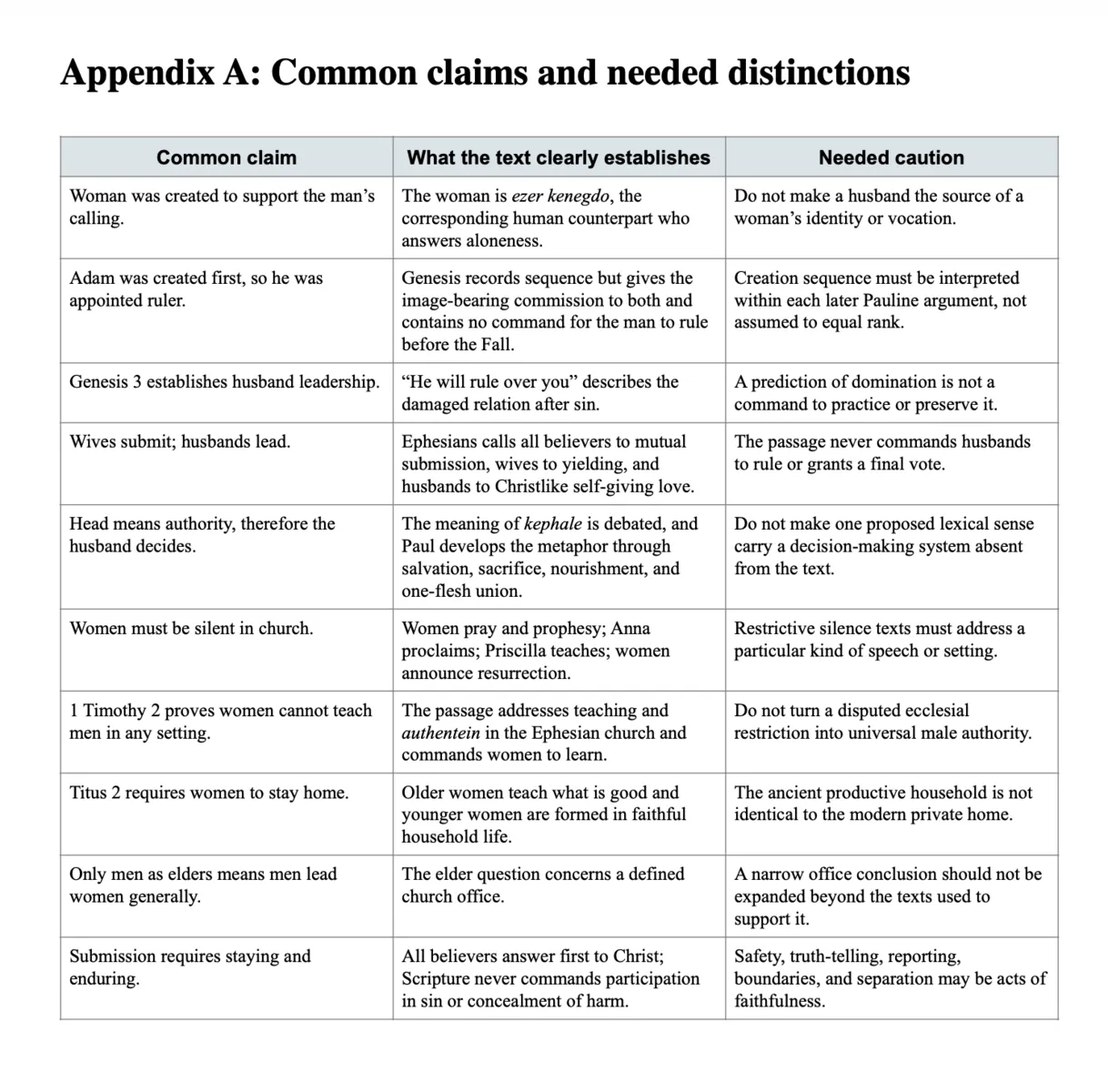
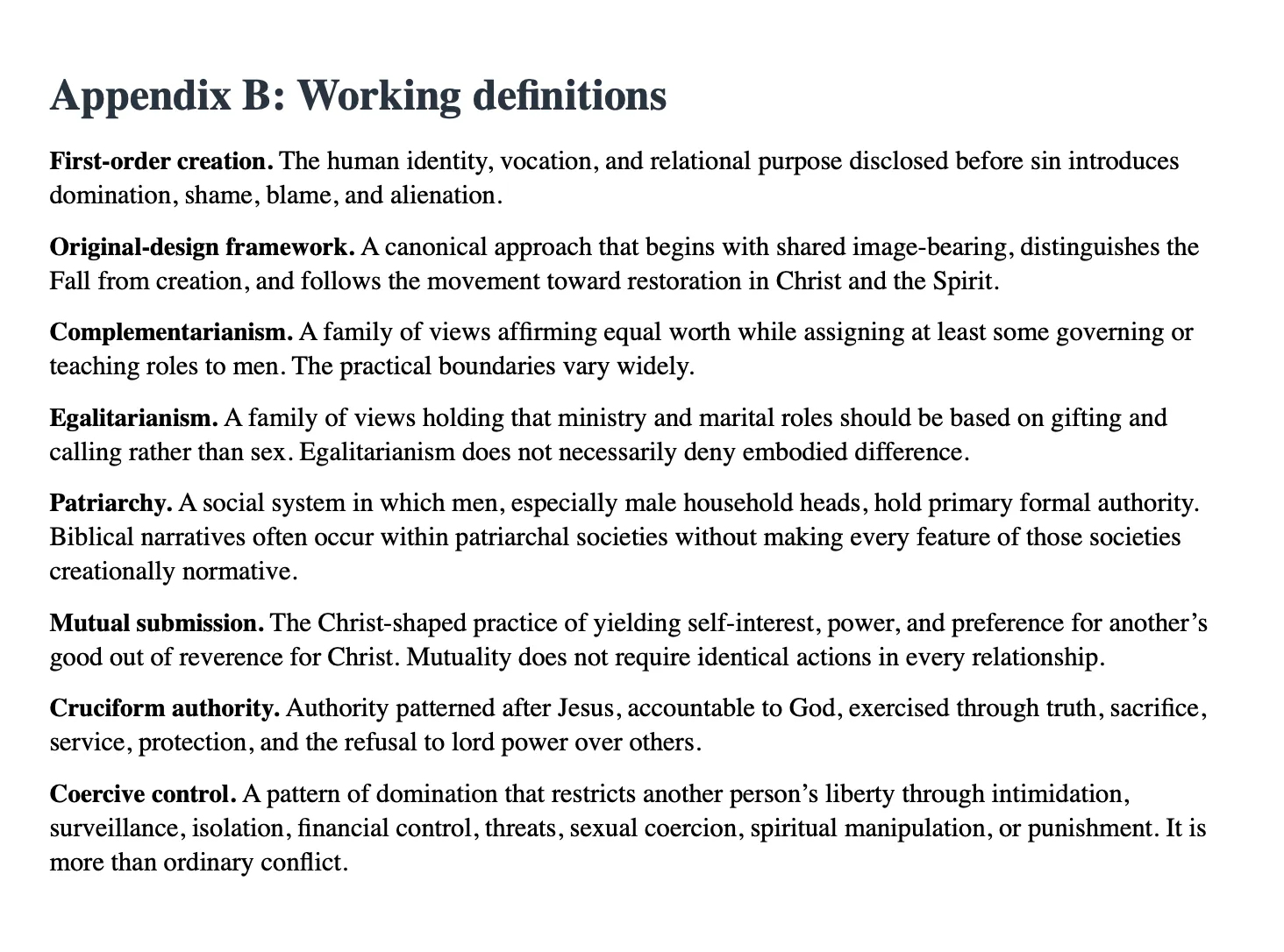
Endnotes
Carmen Joy Imes, Being God’s Image: Why Creation Still Matters (Downers Grove, IL: IVP Academic, 2023). Imes develops the image of God as the common human identity and vocation to represent God’s rule.
For the Hebrew terms, see Francis Brown, S. R. Driver, and Charles A. Briggs, The Brown-Driver-Briggs Hebrew and English Lexicon (Peabody, MA: Hendrickson, 1996), entries for ezer and neged; Ludwig Koehler, Walter Baumgartner, and Johann Jakob Stamm, The Hebrew and Aramaic Lexicon of the Old Testament (Leiden: Brill, 1994-2000). The use of ezer for God does not determine social rank, but it demonstrates that the noun itself does not denote inferiority.
Richard Bauckham, Gospel Women: Studies of the Named Women in the Gospels (Grand Rapids, MI: Eerdmans, 2002), especially his studies of Anna and the women in the resurrection traditions.
Nijay K. Gupta, Tell Her Story: How Women Led, Taught, and Ministered in the Early Church (Downers Grove, IL: IVP, 2023); Cynthia Long Westfall, Paul and Gender: Reclaiming the Apostle’s Vision for Men and Women in Christ (Grand Rapids, MI: Baker Academic, 2016); Craig S. Keener, Paul, Women, and Wives: Marriage and Women’s Ministry in the Letters of Paul (Peabody, MA: Hendrickson, 1992).
Aristotle, Politics, book 1, especially 1.2 and 1.12-13, discusses the household in terms of master-slave, husband-wife, and parent-child rule. For wider first-century context, see Lynn H. Cohick, Women in the World of the Earliest Christians (Grand Rapids, MI: Baker Academic, 2009).
On the grammatical relation of Ephesians 5:21-22 and the supplied verb in verse 22 in early witnesses, see the textual notes in critical Greek editions and Philip B. Payne, Man and Woman, One in Christ: An Exegetical and Theological Study of Paul’s Letters (Grand Rapids, MI: Zondervan, 2009). The grammatical observation does not by itself settle the theology, but it confirms that verse 22 should not be isolated from verse 21.
For a robust complementarian treatment of authentein and 1 Timothy 2, see Andreas J. Köstenberger and Thomas R. Schreiner, eds., Women in the Church: An Interpretation and Application of 1 Timothy 2:9-15, 3rd ed. (Wheaton, IL: Crossway, 2016). For alternative evangelical exegesis, see Payne, Man and Woman, One in Christ; Lucy Peppiatt, Rediscovering Scripture’s Vision for Women: Fresh Perspectives on Disputed Texts (Downers Grove, IL: IVP Academic, 2019); and Linda L. Belleville, Women Leaders and the Church: Three Crucial Questions (Grand Rapids, MI: Baker, 2000).
For respectful presentations and responses from both major evangelical positions, see Stanley N. Gundry, ed., Two Views on Women in Ministry, rev. ed. (Grand Rapids, MI: Zondervan, 2005), with contributions by Linda L. Belleville, Craig L. Blomberg, Craig S. Keener, and Thomas R. Schreiner.
Michelle Lee-Barnewall, Neither Complementarian nor Egalitarian: A Kingdom Corrective to the Evangelical Gender Debate (Grand Rapids, MI: Baker Academic, 2016), is a helpful example of an evangelical attempt to move beneath polarized labels toward kingdom themes, although the framework proposed in this paper is distinct.
On women, marriage, and Paul’s household texts, see Westfall, Paul and Gender; Keener, Paul, Women, and Wives; Peppiatt, Rediscovering Scripture’s Vision for Women; and Payne, Man and Woman, One in Christ.
The claim that harmful fruit should prompt renewed interpretation is not an argument that consequences create truth. It reflects Jesus’ instruction to recognize teachers by fruit (Matt. 7:15-20) and the pastoral obligation to examine whether an application protects or contradicts the vulnerable image-bearers Scripture commands leaders to shepherd.
This paper intentionally distinguishes the narrower elder-office question from a generalized hierarchy. Even complementarian writers differ substantially on the permissions and restrictions outside eldership. See Gundry, Two Views on Women in Ministry, and Kathy Keller, Jesus, Justice, and Gender Roles (Grand Rapids, MI: Zondervan, 2014).
Selected bibliography
Bauckham, Richard. Gospel Women: Studies of the Named Women in the Gospels. Grand Rapids, MI: Eerdmans, 2002.
Belleville, Linda L. Women Leaders and the Church: Three Crucial Questions. Grand Rapids, MI: Baker, 2000.
Brown, Francis, S. R. Driver, and Charles A. Briggs. The Brown-Driver-Briggs Hebrew and English Lexicon. Peabody, MA: Hendrickson, 1996.
Cohick, Lynn H. Women in the World of the Earliest Christians. Grand Rapids, MI: Baker Academic, 2009.
Gupta, Nijay K. Tell Her Story: How Women Led, Taught, and Ministered in the Early Church. Downers Grove, IL: IVP, 2023.
Gundry, Stanley N., ed. Two Views on Women in Ministry. Revised edition. Grand Rapids, MI: Zondervan, 2005.
Imes, Carmen Joy. Being God’s Image: Why Creation Still Matters. Downers Grove, IL: IVP Academic, 2023.
Keener, Craig S. Paul, Women, and Wives: Marriage and Women’s Ministry in the Letters of Paul. Peabody, MA: Hendrickson, 1992.
Keller, Kathy. Jesus, Justice, and Gender Roles. Grand Rapids, MI: Zondervan, 2014.
Koehler, Ludwig, Walter Baumgartner, and Johann Jakob Stamm. The Hebrew and Aramaic Lexicon of the Old Testament. Leiden: Brill, 1994-2000.
Köstenberger, Andreas J., and Thomas R. Schreiner, eds. Women in the Church: An Interpretation and Application of 1 Timothy 2:9-15. 3rd ed. Wheaton, IL: Crossway, 2016.
Lee-Barnewall, Michelle. Neither Complementarian nor Egalitarian: A Kingdom Corrective to the Evangelical Gender Debate. Grand Rapids, MI: Baker Academic, 2016.
Payne, Philip B. Man and Woman, One in Christ: An Exegetical and Theological Study of Paul’s Letters. Grand Rapids, MI: Zondervan, 2009.
Peppiatt, Lucy. Rediscovering Scripture’s Vision for Women: Fresh Perspectives on Disputed Texts. Downers Grove, IL: IVP Academic, 2019.
Westfall, Cynthia Long. Paul and Gender: Reclaiming the Apostle’s Vision for Men and Women in Christ. Grand Rapids, MI: Baker Academic, 2016.
Scripture note
Scripture quotations and wording are drawn primarily from the Christian Standard Bible, with occasional wording from other modern translations where indicated. Hebrew and Greek terms are transliterated for accessibility. This is a pastoral discussion paper rather than a technical commentary; the bibliography identifies fuller exegetical treatments from multiple evangelical perspectives.
Get these by email
New subscribers also receive Above the Noise, a free seven-day listening prayer journal and companion to The Ahava Way.